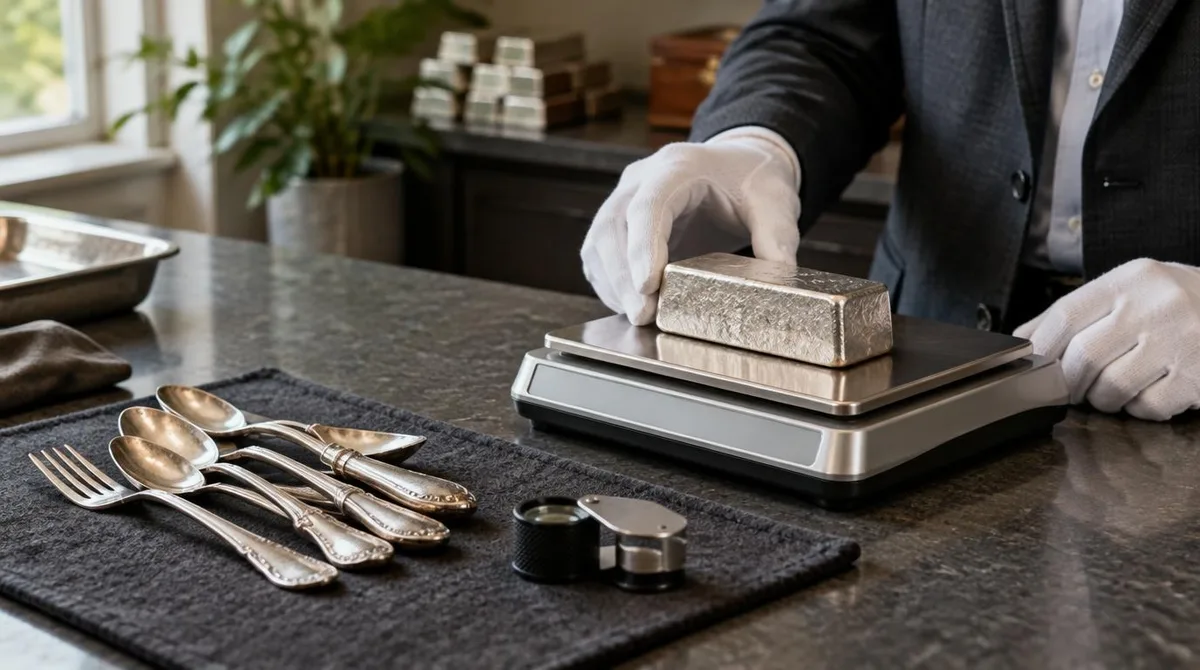
The price of silver per gram is the spot price for a troy ounce divided by 31.1034768, the number of grams in a troy ounce. With silver spot quoted at $42.11 per ounce, that works out to about $1.35 per gram, per Kitco's live conversion table. That figure is a raw metal value, not the price a buyer pays at the counter.
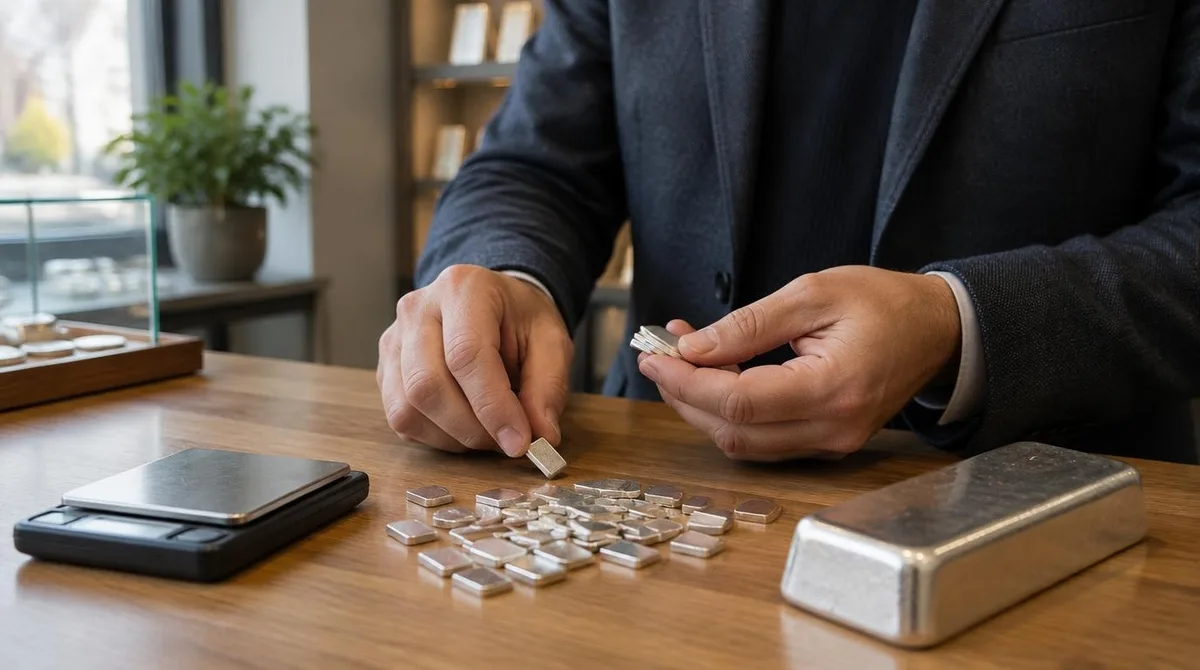
The gap between the two is the premium, and it behaves differently at different weights. A one-kilo bar carries a small markup over spot. A one-gram bar carries a large one, because fabricating and distributing a small piece of silver costs nearly as much as fabricating a big one while holding far less metal. Understanding how the per-gram number is built, and where premiums enter, is the whole practical skill of buying silver in small weights.
This article explains the arithmetic, the premium structure and where to check a live quote. It is market information, not investment advice; buying and selling decisions belong to the reader.
Where does the per-gram silver price come from?
It starts with the spot price: the market price for one troy ounce of silver for immediate delivery, quoted in US dollars. According to Kitco's silver price page, that quote is derived from the most actively traded silver futures contract together with over-the-counter dealing, and it moves nearly around the clock as trading follows the sun from New York to London, Zurich, Shanghai and Hong Kong.
Converting to grams is then a fixed ratio, not a judgment call. A troy ounce is 31.1034768 grams, about 10% heavier than the avoirdupois ounce used for groceries. Divide the per-ounce quote by that number and you have the per-gram spot value. Kitco's table does this live: at the same quote it showed $1.35 per gram, $13.54 per 10 grams and $1,353.71 per kilo.
One caution on units. Bullion trades in troy ounces worldwide, so a "silver ounce" in a price feed is always a troy ounce. Kitchen ounces appear only in everyday contexts, and confusing the two produces a roughly 10% error in any mental conversion.
Why does a gram of silver cost more than the spot math says?
Because physical products trade at a premium above spot that covers fabrication and distribution. Kitco notes that because silver is far less valuable per gram than gold, the premium is proportionally larger: minting a one-ounce silver coin costs nearly as much as minting a gold one, but represents a much bigger share of the metal's value. Scale that logic down to a one-gram bar or a fractional coin and the fixed costs dominate.
The result is a premium ladder. Larger weights sit near the bottom, small weights near the top. The pattern is structural rather than a quirk of any one seller, and it is the same ladder described for bars generally in our Silver Bar Price: Weight Tiers and the Premium Ladder guide.
What this means in practice: the per-gram spot figure is the floor of the conversation, not the price. A buyer comparing a 100-gram bar with ten 10-gram bars is really comparing two positions on that ladder, and the larger unit will almost always carry the lower premium per gram.
How does purity change the per-gram value?
Most silver items are not pure bullion. Investment silver, bars and coins such as the American Silver Eagle, is .999 fine or better, while most jewelry, flatware and household items are sterling silver at 92.5% pure. Purity is expressed as fineness, parts per thousand, and stamped accordingly.
Kitco's purity table converts the same spot quote across common finenesses: .999 fine silver at $1.35 per gram, .958 Britannia-standard at $1.30, sterling at .925 at $1.25, and .900 coin silver, the alloy in pre-1965 US dimes, quarters and half-dollars, at $1.22 per gram. A piece marked 925 therefore contains silver worth 92.5% of the pure silver price by weight.
These are melt values. Kitco states plainly that dealers buying scrap pay below melt, while finished bullion, jewelry and collectible items may trade above their silver content. The scrap side of that spread, including how 925 and coin silver get valued by weight, is covered in our Scrap Silver Price: How 925 and Coin Silver Get Valued explainer.
Where can a reader verify a live per-gram quote?
Three checks, in order. First, a live conversion table. Kitco publishes a 24-hour spot chart that breaks the per-ounce quote into per-gram, per-10-gram, per-kilo, pennyweight, tola and Hong Kong tael figures, converted live from the bid price of the global spot market. The pennyweight, about 1.56 grams, still appears in jewelry trade; the tael, 37.799 grams, in Hong Kong.
Second, a sanity check against the gold-silver ratio. Kitco's page calculates the ratio live from the same spot quotes; at the time of the quoted table it stood at 84.7, meaning one ounce of gold priced the same as 84.7 ounces of silver. The ratio is the oldest relative-value measure in precious metals and has ranged widely in the modern free-market era, so a per-gram silver figure that implies a wildly different ratio than the one on the quote page is worth a second look.
Third, a dealer comparison. Spot sets the floor; the counter price is spot plus a premium that varies by seller, product and order size. Premium and spread claims only mean something when they name the dealer or data source and the date, which is the standard this site applies to its own market notes.
What moves the per-gram price day to day?
The same forces that move the per-ounce quote, since the conversion ratio never changes. Kitco identifies the drivers as monetary ones, real interest rates, the US dollar and investor demand for hard assets, plus industrial demand, which accounts for more than half of annual silver use and includes solar panels, which grew into roughly a quarter of industrial silver demand over the past decade. Supply is constrained too: most newly mined silver is a byproduct of mining copper, lead, zinc and gold, so supply responds slowly to price.
Silver's market is a fraction of gold's size, so the same flows move it further, and it routinely outpaces gold in percentage terms in both directions. In sharp downturns its industrial side can pull it lower even while gold holds firm, as Kitco notes happened in 2008 and March 2020. A reader watching a per-gram chart is watching all of that, compressed.
The wider point about what a price even is belongs to economics rather than the metals desk. As Wikipedia's article on price summarizes, a price is the amount buyers are willing and able to pay that sellers are willing to accept, and for raw materials it is conventionally expressed as currency per unit weight. The same article describes the law of one price: when a good trades at multiple locations, the cost difference between locations cannot exceed shipping, taxes and distribution costs. Silver fits that frame closely, which is why spot converges globally while premiums, the local layer, vary.
What this means for small-weight buyers
Our analysis comes down to separating the two numbers in any silver quote. The per-gram spot value is arithmetic and identical everywhere: per-ounce spot divided by 31.1034768. The per-gram price paid is spot plus a premium set by weight tier, product type and seller, and that premium is proportionally largest at the smallest weights. Comparing offers means comparing premiums, not spot.
Two follow-on reads cover the adjacent cases. For the top of the weight ladder, see Kilo of Silver Price: The 1000-Gram Bar, the Premium and the Resale. And for how silver sits among gold, platinum and palladium as an asset class, the Precious Metals: The Short List and What Makes a Metal Monetary overview gives the context.
What remains unknown in any given session is the premium itself, which is quoted by dealers in real time and changes with inventory and demand. Spot can be verified in seconds; the counter price has to be asked for. Market figures in this article are as of the Kitco table cited above and will have moved since.