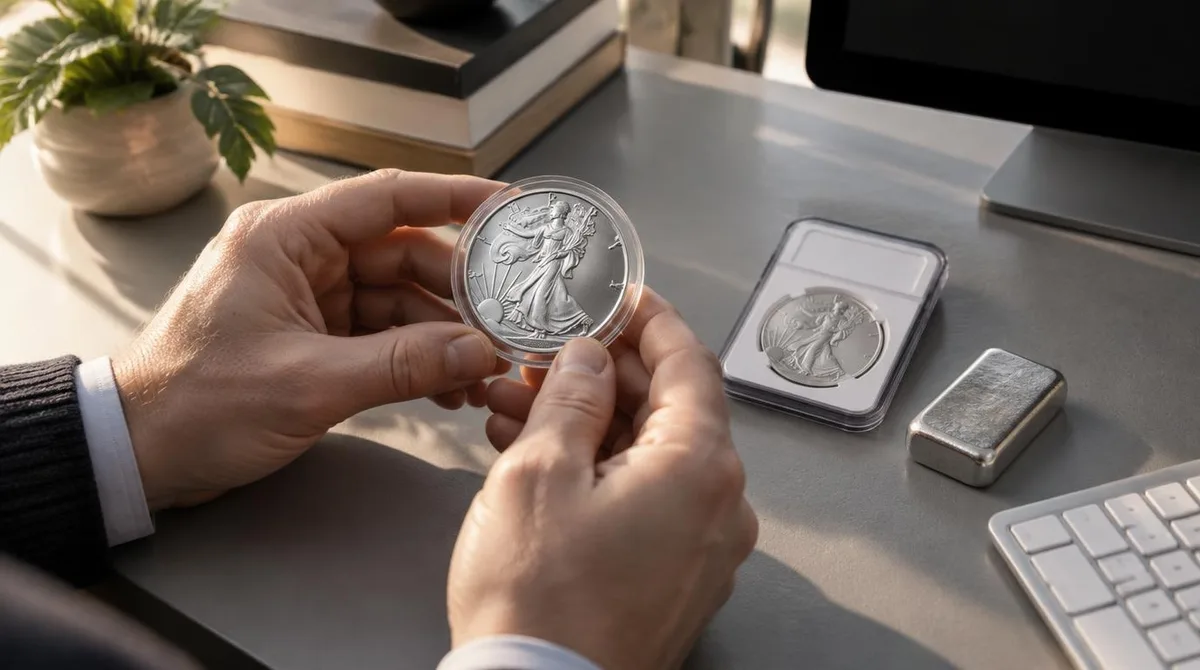
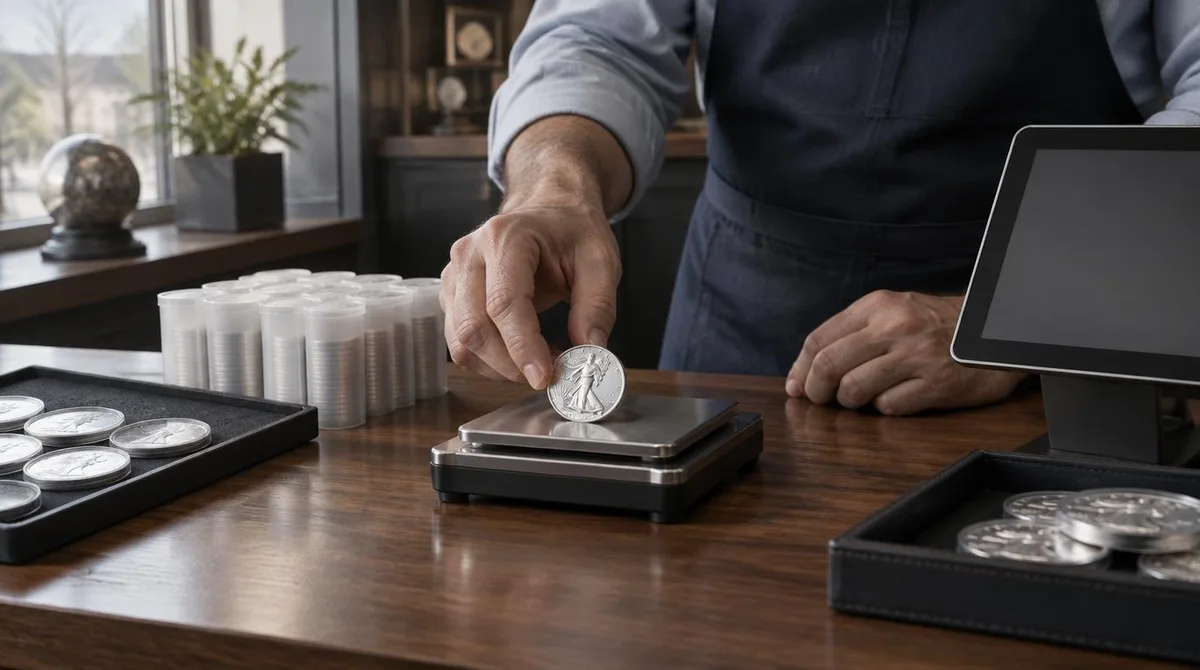
What should you actually pay for an American Silver Eagle today? The honest answer starts with an uncomfortable question: why would a one-ounce coin cost more than an ounce of silver? Because the silver eagle price today is never just the spot quote. It is spot plus a premium, and that premium moves for reasons the spot chart will not show you.
Here is the key term. A premium is the amount a dealer charges above the melt value of the metal, and it covers fabrication, distribution and the dealer's own margin. As bullion dealer APMEX explains in its silver price guide, the difference between a dealer's buy price and sell price generally includes those fabrication and distribution costs — that difference is the premium, and the gap between what a dealer pays and what a dealer charges is the spread.
The limitation to keep in mind: no single published number tells you what you will pay. Spot is the same everywhere at the same moment. Premiums are not. They vary by dealer, by order size and by how fast retail demand is running. So the useful habit is to check spot first, then check what dealers are actually charging above it.
Where does the spot price come from?
The spot price is the market price for one troy ounce of silver for immediate delivery, quoted in U.S. dollars. According to Kitco's silver price charts, spot is derived from the most actively traded silver futures contract together with over-the-counter dealing, and it moves nearly around the clock as trading follows the sun from New York to London, Zurich, Shanghai and Hong Kong.
One unit matters here. Silver is priced in troy ounces, which run 31.1035 grams — about 10% heavier than the everyday avoirdupois ounce used for groceries. If a price quote seems off, check which ounce it uses.
For context on where spot has been trading, Kitco's live table recently showed silver at $52.85 per troy ounce, with a session range from $48.85 to $53.60. Those numbers change constantly, so treat any figure you read — including these — as a snapshot with a timestamp, not a standing price.
Why does the Silver Eagle cost more than spot?
Three costs stack on top of the metal. First, fabrication: minting a finished coin costs real money, and because silver is far less valuable per gram than gold, that cost is proportionally larger. Kitco makes this point directly — minting a one-ounce silver coin costs nearly as much as minting a gold one, but represents a much bigger share of the metal's value.
Second, distribution. Coins move from the mint to authorized purchasers, then to wholesalers, then to dealers. Each step adds handling cost. Third, retail demand. When buying waves hit, premiums widen; when they fade, premiums narrow. Kitco's market notes describe how retail waves — including the 2021 "silver squeeze" — can move silver sharply, and premium behavior follows the same demand pressure.
What this means in practice: the premium is not a fixed tax. It is a live market of its own, and it responds faster to retail buying pressure than spot does.
What drives the premium up or down?
Demand is the biggest lever. The American Silver Eagle is the most recognized government-minted silver coin in the U.S. retail market, and surges in coin buying — often tied to economic worry or price momentum — push premiums up within days. Supply is the second lever. Most newly mined silver is a byproduct of mining other metals, as Kitco's analysis notes, which means mine supply responds slowly to price and cannot quickly relieve a shortage of finished coins. Readers following this should also see Rare Coins: What Rarity Actually Means in Mintages, Grades and Demand.
Mint production matters too. The United States Mint strikes Eagles for sale through its authorized purchaser network, and production levels and product availability at the mint shape how easily dealers can restock. When mint supply is tight relative to demand, premiums climb. When supply is ample and retail interest cools, dealers compete and premiums compress.
Condition and packaging affect price at the margins. APMEX notes that factors like packaging, certified grading from third-party services such as PCGS or NGC, and merchandising can all affect the final price of a silver purchase. But for a bullion-grade, uncirculated Eagle bought by the tube or box, the spot-plus-premium math dominates.
A rising spot price does not mean a falling premium. The two move on separate clocks — spot on the global futures market, premiums on the retail coin market.
How do you read the price you are actually quoted?
Work the comparison in order:
- Check the current spot price from a live source such as Kitco's chart page, and note the time.
- Get the dealer's ask price for the coin, in the quantity you would actually buy — premiums per coin usually drop as quantity rises.
- Subtract spot from the ask. That difference is the premium you are being offered.
- Check the dealer's bid, or buy-back, price. The gap between bid and ask is the spread, and it is the cost you carry if you ever sell back.
APMEX's guide uses a simple illustration of the spread concept: if silver is purchased at $20.00 and sold for $25.00, the spread is $5.00. On a round trip — buy, then sell — you pay the spread plus any change in spot. That is the real transaction cost of owning physical coins, and it is worth computing before any purchase rather than after.
Our analysis: readers comparing the silver eagle price today across dealers should compare the premium over spot, not the raw sticker. A dealer charging a higher total price at a lower premium over that day's spot may be the better deal, especially when spot has moved sharply between quotes.
What about the gold-silver ratio?
Some stackers track the gold-silver ratio — the gold price divided by the silver price — as a relative-value gauge. Kitco's data page currently shows the ratio at 78.2, meaning one ounce of gold prices the same as 78.2 ounces of silver. Kitco notes the ratio has ranged widely in the modern free-market era, from below 20 to above 100, and that a falling ratio means silver is gaining ground against gold.
The ratio is a context tool, not a signal. It tells you how the two metals are priced relative to each other right now. It does not tell you where either is headed, and it says nothing about coin premiums, which is the number that actually determines what you pay for an Eagle.
What this means for collectors and stackers
The silver eagle price today has two parts, and only one of them is public and universal. Spot is the same on every screen at the same moment. The premium is negotiated dealer by dealer, order by order, and it widens and narrows with retail demand and mint supply. Anyone quoting "the" Eagle price without a premium over spot attached is quoting half the picture. We covered a connected angle in Silver Eagle Price: Why One Ounce Costs More Than Spot.
This publication covers market information, not investment advice. Whether a premium is worth paying, and in what quantity, is a decision that depends on your own goals, and consulting a financial advisor about portfolio fit is reasonable — APMEX's own guide says as much. What the evidence supports is narrower and more useful: know the spot, know the spread, and timestamp every number before you act on it.